
New article: 18th century law shows impeachment requires a crime
Examples of high misdemeanors . . . were bribery, assault, and attempted murder.
New article: 18th century law shows impeachment requires a crime Read More »
Examples of high misdemeanors . . . were bribery, assault, and attempted murder.
New article: 18th century law shows impeachment requires a crime Read More »
Britain was the first major country in world history to abolish slavery.
The English tradition of liberty under law is a gift to us all Read More »
The incentives behind the campaign are obvious. The ERA is poorly drafted and vague (which is why it was rejected). If it became part of the Constitution, the result would be legal chaos. Activists know they would be able to feed off that chaos . . . .
The new ERA campaign: constitutional malware Read More »
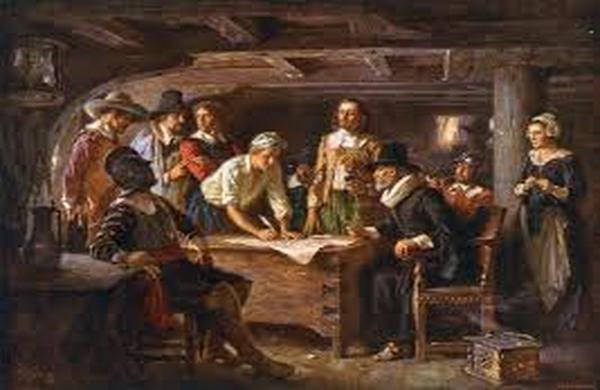
Self-government is at the heart of the American experiment. Historically, it is far more important than some other institutions (such as slavery) that [receive] more attention . . . . .
The Mayflower Compact and “consent of the governed” are now 400 years old Read More »
[T]he search for a single “non-delegation” principle applicable to all congressional powers is a futile one. Instead, the scope of permissible delegation of any particular congressional power must be sought in the meaning of the words describing that power.
How much power may Congress delegate to federal agencies? Read More »
Newsflash for woke “journalists:” Conservatives and libertarians, like others, are entitled speak in their own voices. Not in yours or anyone else’s.
Rob Natelson’s Comment on Jon Caldara and the Denver Post Read More »
[T]he history of anti-sectarian clauses shows that “sectarian” is not a synonym for “religious” and anti-sectarian clauses were not designed merely to discriminate against religion. Instead, they were designed to discriminate in favor of some religions and against others.
Will the Supreme Court strike down bigoted state constitutional rules? Read More »
[S]etting minimum consumption ages is not a power the Constitution grants the federal government. The Constitution reserves it to the states.
Where were all the Constitution’s defenders when the feds raised the smoking age? Read More »
Impeachment law is not for amateurs. It rests on English parliamentary history extending at least as far back as the 1300s. . . .
What the “expert” panel should have told you about impeachment—but didn’t Read More »
These witnesses and their congressional sponsors apparently believe the consensus of professionals should control foreign policy. . . . But the Constitution squarely repudiates this “foreign policy by committee” approach.
Under the Constitution the President, not unelected bureaucrats, makes foreign policy Read More »
Nothing in the Constitution gives [the Speaker of the House a presidential-style veto.
[A] whole generation of law students has been trained to think that the 19th century courts were heartless tools of malicious capitalists, and that enlightened reform came only with the virtuous 20th century “progressives.”
Lies law professors tell Read More »