
A version of this essay first appeared in the June 9, 2025 issue of the Epoch Times.
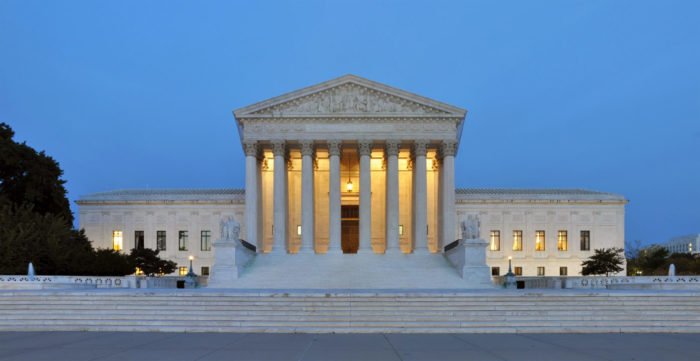
Those of us who have faced discrimination as members of so-called “majority groups”—and, indeed, all people of goodwill—should be cheered by the Supreme Court’s unanimous decision in Ames v. Ohio Department of Youth Services. The case was decided on June 5. Justice Ketanje Brown Jackson wrote the opinion for her colleagues.
The facts behind the case were these:
Marlean Ames worked for an Ohio state agency. She is a heterosexual woman. She joined the agency at the secretarial level, but eventually was promoted to a management position. However, when she sought further promotion, her superiors passed her over in favor of a homosexual applicant. Then they demoted her back to the secretarial level and gave her former job to another homosexual applicant.
Ames filed a lawsuit under Title VII of the Civil Rights Act of 1964, alleging discrimination on the basis of “sex.” However, Ohio is in the sixth federal circuit and in civil rights cases the courts of that circuit had imposed an additional burden on members of “majority groups.” To make out a prima facie (initial) case, members of minority groups had to show only rejection under circumstances suggesting discriminatory motive. But members of majority groups also had to show that the defendant “is that unusual employer who discriminates against the majority.”
There were all sorts of problems with that additional requirement. Justice Jackson outlined some of them and in a concurring opinion Justice Clarence Thomas listed others. The problems included the following:
- The additional requirement was not justified by any wording in the Civil Rights Act.
- Prior Supreme Court case law contradicted it.
- It was difficult to apply.
- As applied to the states, the additional requirement violated the Equal Protection Clause of the U.S. Constitution’s 14th amendment.
- In America today, there are great difficulties in defining what constitutes a “majority group.” In practice, the courts applied the additional requirement only to white males. But, of course, white males are not a majority. They comprise only about 30 percent of America’s population.
- Discrimination against whites, males, and straights is not a practice only of “unusual employers,” but of very many employers. In academia, where I used to work, it was standard procedure. I know: It was open and explicit, and my career suffered for it. (I never traded on the fact that some of my ancestry is Hispanic and American Indian.)
In the face of such concerns, the court, without dissent, swept away the additional requirement.
Some Ironies
As welcome as it is, the decision in Ames v. Ohio contains an oddity and a few ironies. The oddity is that the court repeatedly refers to “Title VII”—but never tells us which statute contains this particular “Title VII.” After all, hundreds of federal statutes are divided into titles, and some of them have Title VIIs. You have to know the inside jargon to realize that the court was referring to the 1964 Civil Rights Act.
The decision was, of course, a defeat for the “diversity, equity, and inclusion” (DEI) agenda of the political Left. But here is an irony: The court could give Ames relief only because the Left had won two prior battles.
The first battle was the passage of the Civil Rights Act of 1964. Older readers may remember that the constitutionality of that law was questioned even by Americans with impeccable civil rights records. The most famous was Sen. Barry Goldwater (R-Ariz.). He had racially integrated his family’s business, co-founded the Arizona chapter of the National Association for the Advancement of Colored People, and ordered the integration of the Arizona Air National Guard two years before President Truman ordered the integration of the military.
No doubt Sen. Goldwater would have supported a constitutional amendment ending racial discrimination. Yet in the absence of such an amendment, he felt forced to vote against the proposed civil rights law because of serious doubts about its constitutionality. The Left, of course, had no such qualms.
Another victory for the Left was the extension of the Civil Rights Act’s ban on discrimination based on “sex” to include sexual preference or gender identity. Congress had intended only to rectify discrimination against women and men. But in a 2020 decision much-celebrated among “progressives,” the Supreme Court extended the law to include gender identity and sexual preference. That case was Bostock v. Clayton County.
Thus, without the Left’s victories in passing the Civil Rights Act despite constitutional doubts and extending it to gender identity and sexual preference, Marlean Ames would not have had a federal cause of action and the Supreme Court would not have inflicted a blow on the leftist “DEI” agenda.
There is another irony in the Ames case as well. Justice Neil Gorsuch, the author of the Bostock opinion, joined Justice Thomas’s concurrence in Ames. The thrust of that concurrence was that judges should not re-write congressional laws by inserting rules or procedures not justified by the text. But that is very similar to what Justice Gorsuch himself did in Bostock and again in the “ghost gun” case of Bondi v. VanDerStok, decided only 10 weeks before Ames.